My current thoughts on AI coding, the good and the ugly

My thoughts on using LLMs in coding boil down pretty simply to a couple points.

First, the way it’s been genuinely useful for me. These are the things I’ve actually done with LLMs in engineering work that left me feeling like it has made a difference. I’ve learned stuff and become a better engineer because of these facets of the tools:

  • Copilot autocomplete is great. Definite time saver. If I understand correctly, Cursor has this as well. Nice.
  • Claude Code with Haiku is great for understanding what a piece of code (not a whole system) is doing or how it works. It’s the staff engineer who can help out when you’re learning something new. (Haiku because you get a longer session before running out of Pro usage)
  • Claude Code with Opus (or often Sonnet) helps with auditing tasks and writing little helper scripts for data processing. Can also be helpful understanding the system, it just uses more tokens than Haiku to do the same thing.

Now the stuff that isn’t so great. This will likely read that I am anti-AI in software engineering, which I’m not, hence putting the things that have gone well first.

  • On the technical tools themselves, all the LLM tooling runs on rails during a session. It will get stuck on doing things a particular way and does not have the ability to think out of the box or discover alternate solutions. It never even asks if a different path is worth exploring. I think this is why so many tend to describe it as a junior engineer you have to coach. Not a perfect analogy because LLMs can write some really complex stuff I wouldn’t expect from a junior, but it does have that junior tendency to “stick to the ticket”.
  • In order to use these tools effectively you have to understand how to set them up properly. Have you tried to look up how to use AI tooling effectively recently? Once you have it installed, you are now faced with a wall of AI hype men telling you why the latest ClaudeCursorGeminiOpenCode feature is a GAME CHANGER. It’s incredibly difficult to find clear, measured, grounded, well-presented information and instructions. This makes learning how to use and keep up with truly revolutionary changes to how we’re working an overwhelming obstacle instead of an inspiring possibility.
  • To further build on that, it’s all moving too fast to keep up with. Unless you do make it your full time job, it’s incredibly difficult to figure out a workflow, prompting methodology and tooling setup that you can gain any mastery over in order to acquire that 10x vibe coding euphoria I keep hearing about. Engineers, at least all the ones I’ve known, love a shiny new thing but at some point have to pick a tool and get back to work. There is a reason you would have to pry Vim out of some engineers cold hands. We need stability to make adoption sustainable.

The final not so great thing isn’t a technology or learning problem. It’s a people problem. There is a message being propagated that if you’re not using AI tooling to vibe code ALL THE THINGS, then you’re NGMI (not gonna make it, for those of us not jacked in 24/7). That your career is doomed, loser, so you better pony up for those millions of tokens and get on board. This isn’t true. Has AI coding changed the tech industry? Yes, permanently and definitively. But it hasn’t reached its final form yet. I look at where we were this time last year and how much has changed even in the last month and I say there’s no way to really predict what will happen. Fear-mongering isn’t going to make these tools any more stable.

We just don’t have enough information yet to know what our industry will look like a year from now. That’s scary enough without bold claims that we’re all going to be replaced. Of course, in the case where AI really does replace software engineers, that means everyone who thinks running a youtube channel teaching engineers how to vibe code and how much of a game changer each iteration of Claude Code is will also be out of work. Glass houses and all.

What being a software engineer means is never set in stone, but right now it is still a vibrant, thriving industry and having a career as a software engineer is still a worthwhile thing to pursue. I am curious to see what this year of “practical adoption” looks like and if we can somehow sort through the hype machines to find a wiser, sustainable way of using these tools to genuinely build something that makes the world a better place.

On the benefits of friction

Before I begin, a quick caveat. All that I’m discussing here should be with the knowledge that I understand that there is a healthy level of challenge and obstacles that enables personal growth as opposed to an extreme where the challenges of living in the world can be oppressive and crushing. I hope you all have the type that helps you grow.


I’ve been thinking about cognitive friction lately, the obstacles in place that teach us how to navigate life’s choices. I sometimes think of this as the concept of constraint as well. Regardless, the idea of friction is an essential tool, a part of being human, that the tech industry is doing its damndest to erase from our lives. I say all this as a member of the tech industry, so know that this is something I’ll be thinking about when making choices about how I write software. My personal mission is to build things that genuinely make people’s lives better, especially in navigating arcane systems. This now includes looking at what problems reduce friction in a way that’s helpful vs those that instead reduce autonomy under the guise of reducing friction.

I recently read an essay that sent me down this thought path. In “In 2026, We Are Friction-Maxxing” by Kathryn Jezer-Morton, the author speaks from the perspective of a parent, but the message resonated with me. It speaks about the better living through escapism that Silicon Valley is selling:

According to the emergent ideology of Silicon Valley, most people would prefer not to be human; they’ve demonstrated this through their revealed preferences in the way they use the apps they’re being sold. That’s all the proof that tech companies need to invest as much money as possible in friction-elimination tools that effectively dehumanize users.

While not a parent myself, I couldn’t get this idea out of my head. Friction is one of the very things that makes us human. Our physical world presents certain obstacles, such as distance, weather, and the concept of time. It shows us that we can’t actually do everything or have everything. We have to make choices, and in doing so we have to hone our discernment. We have to get wiser, or not, and that choice determines what friction we must face next.

You can see the goal of friction reduction in every passive income idea, every productivity hack, every app that promises it will make you better, faster, take away all your pain, do your job for you (I’m looking at you Claude Code and the rest of your buddies). I understand that our current system of capitalism is in part to blame for the desire for easier income, but that’s beyond the scope of this essay, so I shan’t digress.

If an app is making all of your choices, doing all your work for you, and organizing every aspect of your day, who’s life are you living, exactly? Figuring out what’s important to do each day, in your finite number of hours, in partnership with other people, can give meaning to that work no matter what that work entails.

If all that you do is optimized down to the minute and you’re tracking your quality of life down to the calorie consumed or spent, what will you have to talk about at the end of the day? What story will you have to tell your loved ones? Will you even have loved ones? After all, they consume resources and add friction to your life. Life challenges yield stories and aid in a shared understanding of what it means to be human, together.

Our brains are not meant to have it all just as we’re not built to process the 24/7 doom feed of the world. That’s evolved friction and it’s okay to have that friction. There’s value in keeping your focus smaller and doing what’s within your capacity rather than trying to save the world or, as is often the case, carry the grief of the world. We can give a better quality of care if we are fully present with a smaller area of concern.

Friction yields art and innovation. Necessity is the mother of invention. It’s genuinely good for us. I’ve long understood the usefulness of friction since my days as a graphic designer. Creativity in that work thrives on constraints. The example I come back to here is Chip Kidd’s TED talk where he presents various book covers he’s designed and the stories behind the processes. Friction is a key theme here, too. Constraints of technology, of form, of content. The puzzle of creating a cover design that represents the author’s work while also acknowledging that the book needs to sell copies.

I see a small but growing resistance to the frictionless, disembodied existence Silicon Valley would like us to pay our dwindling cash and attention on. I may be partly in a particular bubble created by THE ALGORITHM, but even acknowledging that influence, over the last year I’ve seen an uptick on newsletters, videos, and other posts espousing buying physical media and canceling streaming services. Ironically, despite not being on TikTok, BookTok’s influence on Barnes & Noble felt like the start of it, or at least where I became aware of it. (I do love a good sprayed edge edition)

There are a few themes I see in those transitions beyond the ethical choices folks are making. One is what I’ll call algorithm fatigue, where one starts to get bored of being presented the same artists or similar music over and over and THE ALGORITHM’s grip proves impossible to break out of. Another, more recent theme, centers on a desire to escape the encroaching inevitability of AI Slop overtaking human-created work across media and social spaces.

The third theme is similar to the others as it is partly about running away from something, but it’s about running toward something, too. In this case, running toward a tactile, sensual experience that only physical media can provide. Books have a wonderful smell and heft in the hand. CDs just genuinely sound better and have liner notes. DVDs have special features long abandoned by streaming services.

They all also return us to a place where friction introduces some sort of meaning into the proceedings. You have the constraints of price, shelf space, etc. Choices must be made and in making them we learn a bit more about what we feel is valuable, a bit more about who we are. It’s less disposable, more concrete, and we are more human for those choices.

This doesn’t have to be an all or nothing situation, of course. I’m not likely to unsubscribe from my various streaming services for now. They are convenient and some of my favorite things are just not available in the physical world.

There’s also various accessibility challenges that digital services and apps provide, beyond the more obvious benefits. For myself, I wouldn’t be lost without my digital organization tools (because Bullet Journaling exists) but keeping myself on track with all my projects would be a lot more challenging. I think meditation apps have been a net good benefit to the world. I love that my scale helps me track my ever-shifting weight. Basically, there are various benefits to using the creations that come from the magic of software engineering.

So, with this knowledge that friction is now a shrinking resource and tool, how do we proceed? For myself, I’ll be paying even more attention to where I’m seeking the easy way out and asking why. Why reduce the friction here? What will I be giving up in experience and learning opportunities if I have an app do this for me? Most importantly, how will this choice affect the story I have to tell my loved ones around the dinner table tonight?

Output and Organizing

I don’t know if I’ll ever be able to spell bureaucracy correctly on the first try. The only reason it spelled correctly right now is because spellcheck fixed it for me.

I’m at the point in my life where I’m not worried about that anymore. There’s spellcheck if I really need to spell it correctly and if I don’t have that available, I’ll just spell it wrong and it’ll probably still make sense to anyone reading it who understands the word.

This kind of goes along with something I’ve been thinking about the last few days, which is the chaos that is my digital life. Every once in a while, and by a while, I mean once a month at least, I’ll have the idea that organizing all of my digital existence is a worthwhile endeavor. I make a plan and then instantly get overwhelmed by it. The scope is too big, the files are spread across too many drives and cloud services and just scattered everywhere.

I was thinking about another one of those runs at trying to reorganize when I came across somebody talking about creative work and that for Neurodiverse folks like me a lot of times we get hung up on all of that planning and immediately getting overwhelmed by things.

Which of course rang very true for my own experience. The advice that person gave is to just embrace the chaos. Just get the words out, get the music out, get the art out with whatever is that hand and whatever is working for your brain. Because the work is the most important part, not whether you have everything organized in time stamped folders and files.

So I’m sitting with this now, this idea that I can just let the chaos reign and write a zine like this one using the dictation option in the Notes app on my phone. It doesn’t matter if this ever gets into my organized writing folder and notebook, although I hope it does. It doesn’t even really matter how polished it is. What’s more important is that I finish the work and share it.

Which if you are holding this in your hands and reading, it means I’ve succeeded.

Making the work and sharing it. That’s all that really matters in the end. I’m gonna do more of that.

DIY Rubber Bridge: Modifying an acoustic guitar

Introduction

After watching an episode of the JHS show (my current favorite guitar channel) featuring a parlor guitar with a rubber bridge, I fell in love with the sound. The guitar in the video is available for pre-order, however it carries a hefty price tag ($675). However, I have a similar guitar and was inspired to do some work to see if I could DIY my own rubber bridge.

Benefits of a rubber bridge and lower tuning

In short, a rubber bridge sounds interesting and unique. Also, all the cool kids are doing it. The sound of the guitar is deadened a bit, placing it somewhere between a ukulele and a guitar. As in the video, I also detuned the guitar to a baritone tuning (BEADF#B), which gave this small guitar a depth it didn’t have before.

Norma: the Guitar

Norma is a late 1960s parlor guitar meant for campfire singalongs and beginners. It’s ¾ scale and made in Japan. There are some more general details about the guitar here: Late 1960s NorMa Parlor Guitar

Downsides

The only significant downside to the rubber bridge is that it will wear out over time as the strings vibrate as they press into the rubber. That said, the material was very inexpensive and will only take a few minutes to cut a new bridge as needed.

Replacing The Bridge

The prep and research

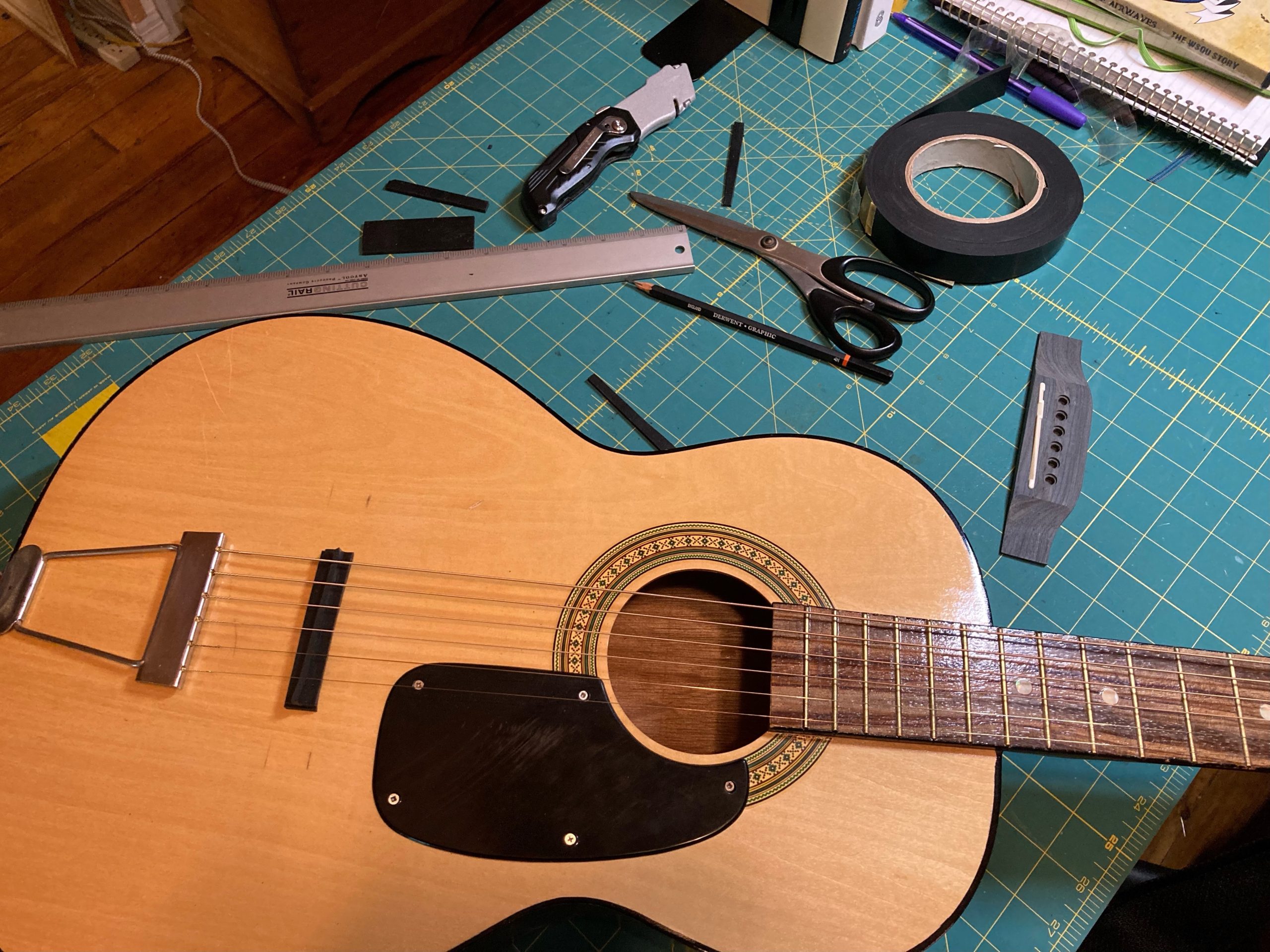
I’ve already done a bit of work on this guitar, including cleaning up the frets and swapping out the original bridge in order to lower the action (how high the strings are from the fretboard) to make it more playable. I wasn’t happy with the changes I made as the action was still too high. This rubber bridge idea gave me a path to fixing the action problems.

After watching (including a failure) and doing some research on what solid neoprene rubber gasket/weather stripping which fulfilled the same purpose but was more flexible for making granular adjustments in size, height, etc.

The modification process

Removing the old bridge

Swapping out the bridge on this guitar is incredibly easy because it’s what’s called a floating bridge. It’s not glued down and the strings run through the tailpiece rather than through the body of the guitar.

So, the only step here was to remove the old bridge, which took about 5 seconds. Just lift the strings and slide it out.

Cutting a new bridge

Adding the new bridge took a little trial and error. First I just cut bridge-width strips of rubber off the roll. 1/8th inch wasn’t enough, but ¼ inch was about right. I installed it, tuned the guitar and played.

The good news was that it worked! The downside was that it was both a little too low (the strings buzzed a lot against the frets) and really deadened the sound too much. I needed a smaller point of contact for the strings.

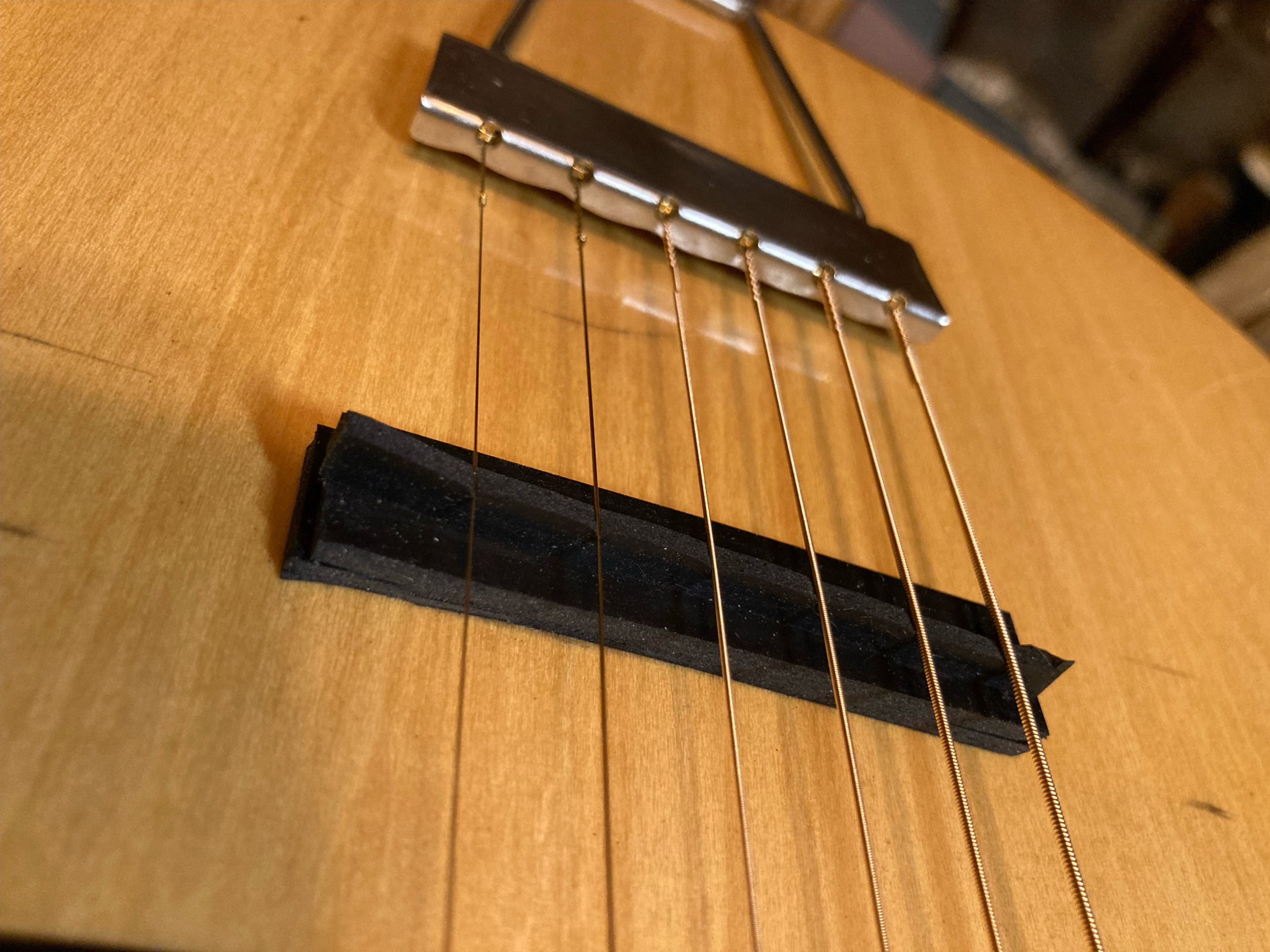
My second attempt was to cut the strips in half and then add a third strip to the stack. This yielded a 3in x 1/2in x ¾ in strip. I installed this version and it was an incremental improvement. The sound was a little brighter and more resonant, but could have been better. And now the string action was too high again.

I didn’t want a full 1/8th of height so I cut a strip a bit smaller than that, just eyeballing rather than measuring and turned it on its side on top of the 2 1/8in strips I kept as the base.

This worked as near to perfect as I could hope for! The sound is deadened, but not too much and the action is still high enough to not buzz too much on the frets.

Next Steps

There are still some fixes I want to do.

  • First priority is getting and installing a pickup so I can run the guitar through an amplifier and, most importantly, through my effects pedals.

  • Scrape the fretboard down to remove the factory polyurethane finish. It doesn’t look very nice.

  • Replace the tuning pegs. One of them is a little loose and this would improve the way the guitar holds tune.

Social media nomad

I’ve become a social media nomad and now that I see it, I’ll probably be more intentional about it.

I’ve stopped going to twitter entirely unless someone links me to something interesting. That’s been that way for a long time.

Most of my social energy the last couple years has been spent in the work slack, which is very active. This is fine, but I don’t want to lose those outside connections.

Mastodon in general has been great as a home base for connecting and random thoughts. I’ve met awesome people. If we’ve chatted, I probably consider them an internet friend.

I’ve been on various slack groups and discords over the years, some of them I’ve been on long enough that they feel like home and where my other internet friends live.

And over the last couple of months I’ve re-engaged with tumblr, which surprised me, but it’s just where I left it years ago and sometimes I need that chaotic rabid fandom energy in my life.

But I don’t feel completely tied down to any of these places and honestly barely spend more than a few minutes a week on any one of them. Some I don’t visit for months at a time. My various websites gather dust too, my profiles rarely get updates. I lurk a lot.

This ties into an idea my family chatted about recently around travel. We don’t travel, for the most part. Most of the world doesn’t travel either, and that’s okay. We talked about where that travel urge came from and if there was a way we would consider doing so. And we thought about migration patterns, the way nomadic tribes follow animal migrations. This is a form of travel, but when you come around to each seasonal place, you’re really home, just a different one. I imagine wealthy people with homes around the world are instinctively doing something similar. They’re not really traveling, because the place the go is familiar, it’s home.

I seem to be doing the same thing with my internet presence. I’m migrating from place to place, never too long in one. I think this is okay, it’s healthy. I’ll keep being a digital nomad, thanks.